
 Available in US
UK rugby betting tips used to be little more than a gut feeling and a glance at the team sheet pinned to the clubhouse wall. That world is gone. The UK sports betting market generated over $11.2 billion in revenue in 2024 alone, with projections pushing that figure past $21 billion by 2030 — and rugby, both Union and League, commands a growing slice of that turnover. Roughly one in ten UK adults now places a sports bet online in any given month, and a significant chunk of that activity lands on rugby markets every autumn, winter and spring.
I have spent nine years dissecting rugby odds across every major competition — from Premiership weekenders to the final day of the Six Nations, from soggy Challenge Cup ties to the sharp, fast markets of the SVNS circuit. In that time I have watched the betting landscape shift from a handful of match-winner markets to a sprawling ecosystem of handicaps, player props, bet builders and in-play options that update with every scrum reset. The volume of data available to an informed bettor today would have been unthinkable a decade ago, yet most of the rugby betting advice published online barely scratches the surface. You get the same recycled tips — "check the team news", "watch the weather" — without the numbers to back them up or the strategic framework to make them useful.

This guide is built differently. Every section draws on verified market data, regulatory filings and competition statistics to give you a decision-making edge rather than vague encouragement. I will walk you through the UK betting landscape, the tournaments that generate the deepest markets, the core bet types worth mastering, and the practical disciplines — staking, form analysis, in-play timing — that separate sharp bettors from casual punters. Whether you follow Union, League or both, the analytical principles are the same: understand the numbers, respect the variance and never confuse entertainment with strategy.
One thing you will not find here is a promise of guaranteed returns. Anyone offering that is either lying or about to ask for your credit card details. What I can offer is a structured, evidence-based approach to rugby wagering that has kept my own bankroll intact across nine seasons of professional analysis — and the tools for you to build yours.
What Nine Years of Rugby Betting Analysis Boils Down To
- The UK sports betting market generated over $11.2 billion in 2024, with rugby commanding growing volume around the Six Nations, Premiership play-offs and Super League — the three deepest market windows for rugby bettors.
- Master three core markets first: match winner, handicap and over/under totals. Player props and exotics carry higher margins and demand more specialised research.
- Union and League are separate betting disciplines. 33% of Premiership Union matches finish within seven points; League produces wider margins and higher totals. Never transplant a model from one code to the other.
- Flat staking at 1-2% of your bankroll per bet protects you through losing streaks and removes the illusion that confidence-based sizing works. Process beats conviction.
- UK regulation is tightening — stake limits, sponsorship reform, and 741 enforcement actions in 2025-2026 signal a market that rewards licensed, disciplined bettors.
The UK Rugby Betting Landscape in Numbers
Three years ago a colleague told me that rugby betting was "too niche to bother modelling properly." I pulled up the Gambling Commission's quarterly filings, ran the numbers, and sent him a one-line reply: "Niche doesn't mean small." He has been modelling rugby since.
The raw figures tell the story. Remote betting — the category that covers every online sportsbook wager placed from a UK device — produced GGY of £16.8 billion across the 2024-2025 financial year. Sports betting accounts for 57.1% of all online gambling revenue in the UK, making it comfortably the largest segment ahead of casino and poker combined. Rugby sits inside that segment alongside football, horse racing, tennis and cricket, and while it does not command football's headline share, its betting volume spikes dramatically around marquee fixtures in ways that create exploitable market inefficiencies.
Remote Betting GGY
£16.8 billion across the 2024-2025 financial year, covering all online sportsbook wagers from UK devices.
Sports Betting Share
57.1% of UK online gambling revenue comes from sports betting — the single largest segment.
Adult Participation
47% of UK adults engage in some form of gambling; 10% actively bet on sports online.
Mobile Dominance (18-24)
76% of bettors aged 18-24 place wagers via mobile devices, making app-based in-play markets the default.

Participation data adds another layer. Gambling Commission surveys show that 47% of UK adults participate in some form of gambling. Strip out the National Lottery and scratch cards, and the figure drops to 26% — still a massive pool. Among those, 10% are active online sports bettors, the demographic most likely to engage with rugby markets during tournament windows. Andrew Rhodes, the Gambling Commission's Chief Executive, put it plainly when he noted that participation remains stable at around 48% of the adult population, with the total market valued at roughly £15.6 billion excluding lotteries. That stability matters for bettors: it means liquidity is predictable, not speculative.
The generational shift in how bets are placed reshapes the market too. 76% of the 18-24 age group use mobile devices for their wagers. That statistic is not just a demographic curiosity — it directly influences which markets bookmakers prioritise. In-play rugby betting, which demands real-time interaction, has become the default mode for younger punters. If you are still placing your bets at a desktop on a Saturday morning, you are competing against a cohort that has the odds refreshing in their pocket while they watch the match live.
The UK accounts for 9.4% of the global online gambling market and leads all European nations by revenue. When a Six Nations match kicks off, UK-based bookmakers are processing wagers in one of the deepest, most liquid sports betting pools on the planet.
What does all of this mean for your rugby wagers specifically? Two things. First, the sheer scale of the market means that major rugby fixtures — particularly Six Nations, Premiership play-offs and Super League derbies — attract enough volume for bookmakers to price them competitively. Tighter margins equal better value for the bettor who shops lines. Second, the mobile-first trend means in-play markets are deeper and more responsive than they were even two seasons ago. If you are not at least considering live betting as part of your rugby strategy, you are leaving edges on the table.
Major Tournaments That Drive Rugby Betting Volume
I keep a spreadsheet that tracks how my own betting activity distributes across the calendar year. Without fail, three quarters of my rugby wagers land in the windows around the Six Nations, the Premiership play-offs and the Super League run-in. That is not habit — it is where the markets are deepest and the data is richest.
Six Nations: The Volume King
No rugby competition on Earth generates betting interest like the Six Nations. The tournament's commercial weight is staggering: broadcasting agreements with UK, French, Italian and Irish networks generated $135.24 million in media revenue for the 2025 edition alone. Over 1,050,000 spectators passed through stadium gates that year, averaging 70,031 per match — and every one of those fixtures was priced by every licensed UK bookmaker across dozens of markets.
Television audiences amplify the effect further. The 2026 final between France and England, a 48-46 thriller, drew a peak audience of 9.5 million on France 2 — 42.5% of the national viewing share. On UK screens, ITV consistently pulls multi-million audiences for Saturday afternoon fixtures, meaning casual viewers become casual bettors at a rate no other rugby event can match. Navin Singh, the Six Nations' Chief Commercial and Growth Officer, has described the tournament experience as "unlike anything else in sport" — and for bettors, the practical consequence of that unrivalled attention is market liquidity you simply do not find elsewhere in rugby.
The depth of Six Nations markets means handicap lines are tighter, in-play options are broader, and the range of player props available on a single match can exceed thirty. If you are serious about rugby betting, the Six Nations is where your preparation should be sharpest. I cover the full strategic breakdown — outright value, round-by-round timing, accumulator discipline — in a dedicated Six Nations betting tips piece.

Six Nations 2025 Media Revenue
$135.24 million from broadcasting agreements across four nations.
Six Nations Stadium Attendance
1,050,465 spectators across the tournament, averaging 70,031 per match.
Super League 2025 Record
Over 1.62 million spectators for the regular season, with TV viewership up 52% year-on-year.
Super League and Premiership Rugby: Domestic Volume
While internationals dominate the headlines, domestic rugby generates consistent, week-in-week-out betting opportunities that many punters overlook. Super League in 2025 broke its attendance record for a twelve-team season, pulling more than 1.62 million spectators through the turnstiles and recording a 52% increase in television viewership. Those numbers translate directly into deeper match-day markets, particularly for Friday and Saturday evening fixtures that attract in-play activity.
Premiership Rugby operates in a similar rhythm. Its most recent full season drew over 1.4 million fans, with the Twickenham final attracting a record crowd of 81,669. The Premiership's compressed play-off format, where four teams contest semi-finals and a one-off final, creates concentrated betting windows with heightened volatility — exactly the conditions that value-focused bettors should target.

The Wider Calendar
Beyond the big three, the Champions Cup adds a cross-league European dimension, autumn internationals pit hemispheres against each other in November, and the British and Irish Lions tour returns on a four-year cycle with its own unique market dynamics. Even the SVNS sevens circuit and the expanding women's calendar are beginning to generate meaningful odds. The key insight is that rugby's betting calendar does not have an off-season — it has peaks and plateaus, and your staking strategy should reflect the difference.
Understanding which tournaments generate the deepest markets is the first step; the next is knowing what to do once those markets open.
Core Rugby Betting Markets You Need to Know
Early in my career I made the mistake of spreading my bankroll across every market a bookmaker offered on a single Premiership fixture — match winner, first try scorer, half-time result, total penalties, you name it. I backed seven different bets on one match and won precisely one. The lesson was expensive but simple: master the core markets first, then expand. For rugby, that means three bet types deserve your attention before anything else.
Match Winner
The most straightforward rugby market asks you to pick the team that finishes with more points at full time. In Union, most bookmakers offer a three-way market — home, away, or draw — while League matches, which are less likely to end level, sometimes default to a two-way line with a draw as a dead-heat void. The match-winner market is where I start every analysis because it forces the most fundamental question: who is going to win, and how confident am I in that assessment?
Pricing on match-winner markets is typically the tightest of any rugby bet, because it attracts the highest volume. That is both an advantage and a limitation — the odds accurately reflect public expectation, which means finding value requires you to identify something the market has underweighted. Late team news, recent form discrepancies, or specific venue factors are the usual levers.
Handicap — a points adjustment applied to one team before kick-off. If you back a team at -7.5, they must win by eight or more points for your bet to land. The handicap exists to level the perceived gap between two unevenly matched sides.
Handicap Betting
Handicap betting is where rugby markets get genuinely interesting. The bookmaker assigns a positive or negative points spread to each team, and your bet settles against the adjusted scoreline rather than the actual result. A -5.5 handicap on England means they need to win by six or more; a +5.5 on Italy means the Italians can lose by up to five points and your bet still pays.
Why does this matter? Because rugby is a sport of margins. Matches frequently hinge on a single converted try in the final quarter, and the handicap market lets you express a view on the degree of dominance rather than just the binary outcome. I cover the mechanics, the distinction between European and Asian lines, and the situational edges in a full rugby handicap betting guide.
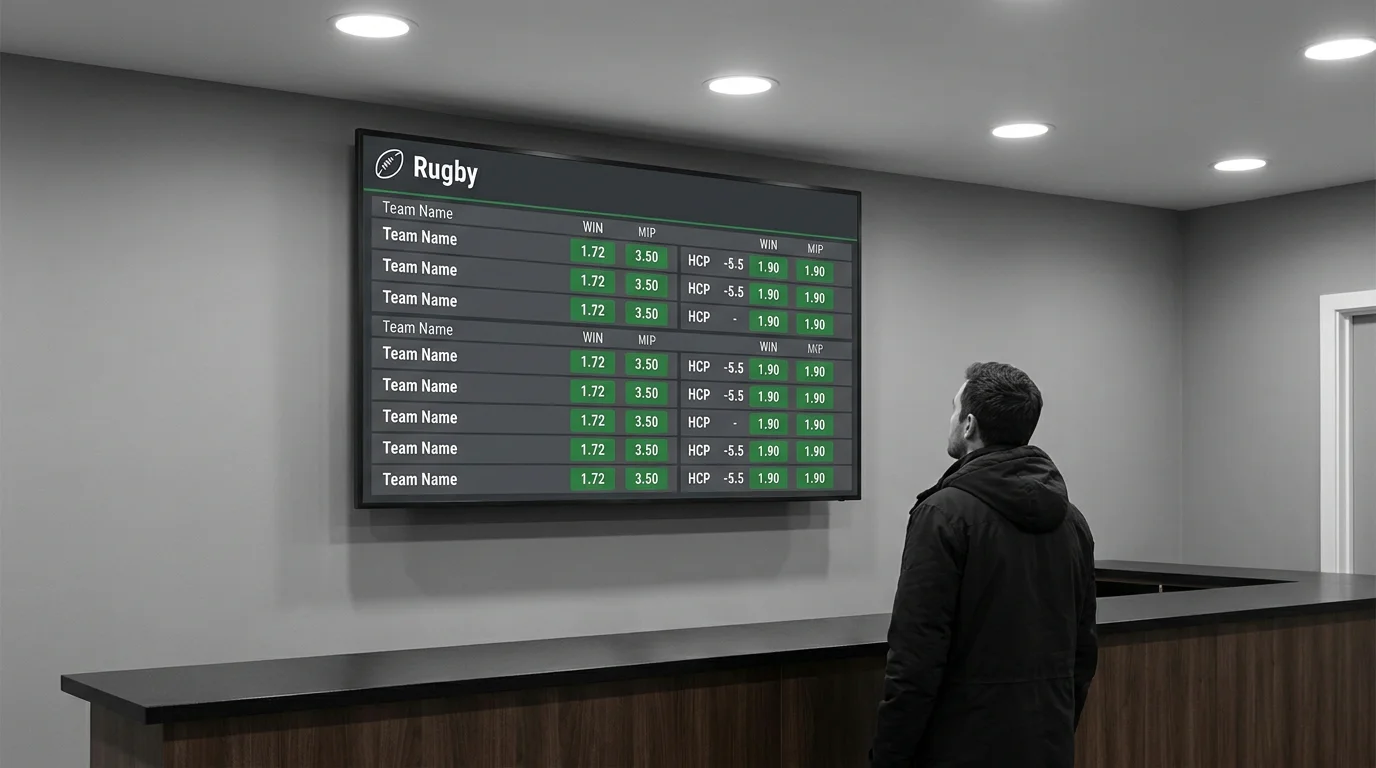
| Market | Selection | Odds |
|---|---|---|
| Match Winner | Home | 1.55 |
| Match Winner | Away | 2.50 |
| Handicap -7.5 | Home | 1.90 |
| Handicap +7.5 | Away | 1.90 |
| Total Points Over 44.5 | Over | 1.85 |
| Total Points Under 44.5 | Under | 1.95 |
Illustrative odds for a hypothetical Premiership fixture. Real prices will vary by bookmaker and timing.
Over/Under Totals
The totals market asks whether the combined score of both teams will finish above or below a line set by the bookmaker. A typical Premiership Union fixture might be lined at around 44.5 total points; a Super League match, given the code's higher scoring tempo, could sit closer to 48.5 or above.
Accumulator — a single bet combining multiple selections across different matches. All legs must win for the bet to pay. Accumulators amplify both potential returns and risk, and they carry a hidden margin cost that compounds with every leg added.
Totals markets reward the bettor who can read conditions: a wet evening at a windswept ground in Galway is a different proposition from a dry afternoon at a covered stadium. I find that combining totals analysis with weather data and set-piece efficiency stats produces the most consistent edge of any rugby market I track.
Player markets — first try scorer, anytime try scorer, man of the match — and exotic bets like winning margin or half-time/full-time results sit beyond these three core markets. They carry higher bookmaker margins and demand more specialised research. Build your analytical framework on match winner, handicap and totals before branching out.
Union vs League: How the Code Changes Your Bet
A friend who bets exclusively on Super League once asked me to help him with a Six Nations accumulator. He looked at the totals lines and said, "These are absurdly low — how does a match finish under 40?" He was thinking like a League bettor. That instinct, carried across codes without adjustment, is one of the most common and most expensive mistakes in rugby wagering.
Rugby Union and Rugby League share a name, an oval ball, and very little else when it comes to betting dynamics. Union is a fifteen-a-side contest built around set pieces — scrums, lineouts, mauls — that slow the game down, reduce possession cycles and produce lower aggregate scores. League strips the squad to thirteen, replaces contested scrums with controlled play-the-balls, and enforces a six-tackle turnover that accelerates the tempo. The scoring differences flow directly from the structure: a Union try is worth five points with a two-point conversion available, while a League try is worth four with a two-point goal kick. Those margins compound across eighty minutes.
| Factor | Rugby Union | Rugby League |
|---|---|---|
| Players per Side | 15 | 13 |
| Try Value | 5 points | 4 points |
| Typical Totals Line | 38-48 points | 42-54 points |
| Set-Piece Complexity | High (contested scrums, lineouts) | Low (uncontested restarts) |
| Game Tempo | Stop-start, territory-driven | Continuous, completion-driven |
| Home Win Rate (Domestic) | 64.2% (Premiership) | Slightly lower, venue-dependent |
| Key Handicap Factor | Set-piece dominance, kicking game | Completion rate, ruck speed |
The practical betting implications are significant. In the Premiership, around 33% of matches finish with a margin of just one to seven points, and home teams win 64.2% of the time. Those two facts alone reshape your handicap analysis: tight Union margins mean that covering a -7.5 spread is a genuinely difficult proposition, while the home advantage premium is large enough to factor into every match-winner assessment.
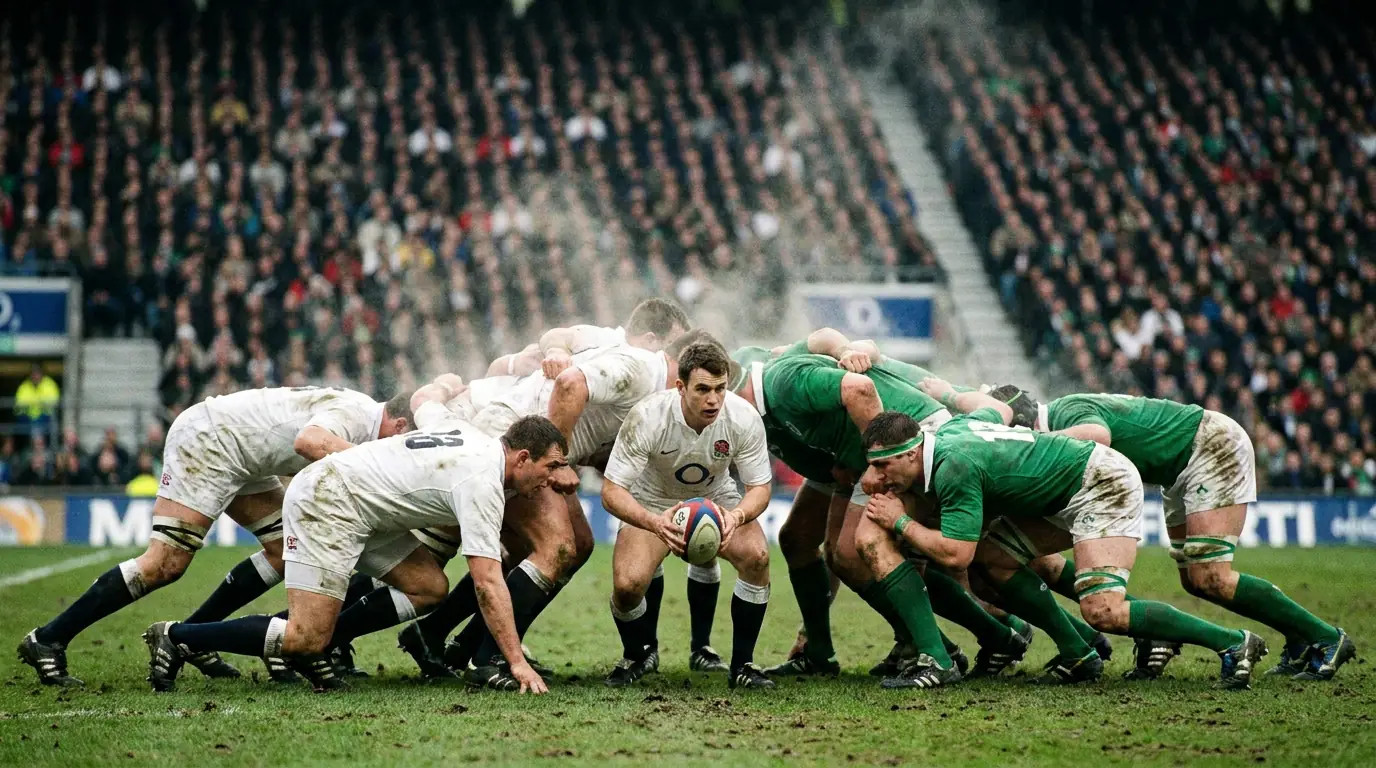
League, by contrast, tends to produce wider margins and higher combined totals, making the over/under market more central to your strategy. The six-tackle possession cycle means that momentum swings are sharper and more frequent, which affects in-play odds more dramatically than in Union. If you bet on both codes, treat them as separate disciplines with separate models. I go deeper into League-specific patterns — scoring profiles, seasonal trends, Magic Weekend dynamics — in the rugby league betting tips article.
Knowing the structural differences between the codes is analytical groundwork; the next step is learning how to read a match before it starts.
Reading the Form: Stats, Conditions and Team News
Last autumn I placed what I thought was a well-researched handicap bet on a Premiership match. I had the recent form nailed, the head-to-head record favoured my selection, and the totals aligned with my model. What I had not done was check the team sheet released forty-eight hours before kick-off. The starting fly-half was rested for an academy player making his second senior appearance. My bet lost by the exact margin that the kicking game evaporated. I have not skipped the squad announcement since.
Form analysis in rugby is not complicated, but it is layered. No single data point tells the whole story — you need to stack multiple signals to build a picture that is stronger than any individual input. The five pillars I run through before every bet are recent results, injury and squad news, weather conditions, head-to-head record, and venue specifics.
Recent results matter, but context matters more. A team that lost two straight by narrow margins against top-four opposition is in a different position from one that dropped points against teams below them. I look at the last five fixtures as a default window, filtering for competition type — a Champions Cup loss in France carries different weight from a Premiership loss at home. Scoring trends within those five games reveal whether a team's attack or defence is improving, stalling, or declining, and that trajectory often predicts the next performance better than a raw win-loss count.
Injury reports deserve forensic attention. In rugby, a single absence can reshape a match. Lose a front-row anchor and the scrum platform deteriorates. Lose a goal-kicking fly-half and the team's ability to convert territory into points drops sharply. I cross-reference the named squad with training reports and social media activity from the club — not because Twitter is a reliable source, but because clubs occasionally leak return-from-injury news informally before the official announcement.
Check the named squad no later than 48 hours before kick-off. In both Union and League, teams are required to submit matchday squads in advance, and late changes — tactical or injury-driven — can shift the handicap line by several points. If you place your bet before the squad is confirmed, you are gambling on information you do not have.

Weather is the factor that separates the diligent from the lazy. Rain, wind and cold do not just "make it harder" — they alter the game's strategic DNA. A heavy downpour reduces handling quality, compresses the score, and pushes totals under. Wind, particularly cross-field gusts at exposed grounds, wrecks the kicking game and disproportionately affects the team kicking into it in the second half. I check the forecast at ground level, not the regional overview — conditions at a coastal venue like the Liberty Stadium can differ sharply from a sheltered city ground twenty miles inland.
Head-to-head records and venue history round out the picture. Some matchups produce consistent patterns — one team's defensive structure might neutralise another's attacking shape season after season. Ground dimensions, pitch surface type, altitude and crowd density all feed into venue-specific performance data that is publicly available but rarely factored into casual betting decisions.
Pre-Bet Form Checklist
- Last five results — filtered by competition type and margin
- Squad announcement — confirmed starting XV/XIII and bench composition
- Key absences — front row, fly-half, goal-kicker, primary ball-carrier
- Weather forecast — ground-level conditions, not regional
- Head-to-head record — same venue, same competition phase
- Travel and schedule — midweek turnaround, long-distance away trip, international release
None of these steps is revolutionary. The edge comes from doing all of them, consistently, for every bet. Most punters skip at least two.
In-Play Rugby Betting: Timing and Triggers
The first time I placed a live bet during a Six Nations match, I panicked. A yellow card was shown in the 52nd minute, the odds shifted within seconds, and by the time I had decided what to do, the value had already narrowed. That fumble taught me the single most important lesson about in-play rugby betting: you cannot react in real time if you have not prepared in advance. The window between a game-state change and the market's adjustment is narrow — sometimes under thirty seconds for major bookmakers — and the only way to exploit it is to know what you are looking for before the match starts.
In-play rugby betting has grown explosively as mobile devices have become the primary betting channel. The markets now available during a live match go well beyond a simple updated match-winner line: you can bet on the next team to score, the method of the next score, total points in a half, individual try scorer in a window, and handicap lines that recalculate after every scoring event. The depth is genuinely useful for the prepared bettor, but it is a trap for the impulsive one.
The triggers that shift live odds most dramatically in rugby are consistent and predictable. A sin bin — ten minutes with fourteen players in Union, or a player in the bin in League — creates a measurable scoring asymmetry. Momentum shifts after a break from deep, a turnover on the opposition's five-metre line, or a string of penalties at the scrum all alter the probability surface. Even a first-half injury to a key player can unlock second-half handicap value that the pre-match line did not anticipate.
Do
- Pre-identify two or three specific scenarios before kick-off that would trigger a live bet
- Act within the first 30 seconds after a sin bin is shown — the market adjusts fast
- Use momentum shifts (line breaks, repeated penalties) as entry signals for next-score markets
- Set a hard limit on the number of in-play bets per match — I use a maximum of two
Avoid
- Chasing a lost pre-match bet with a live bet designed to recover the stake
- Betting on every scoring event — high frequency erodes your edge through margin
- Ignoring the clock — a sin bin in the 75th minute carries far less weight than one in the 50th
- Relying on broadcast commentary for game-state assessment instead of watching the actual patterns of play

The discipline required for in-play betting is higher than for pre-match wagers, and the emotional pull is stronger — you are watching the match, your adrenaline is engaged, and the "one more bet" impulse is real. I break down the full framework — timing windows across the eighty minutes, environmental triggers, cash-out decision trees, and the psychology of staying disciplined — in the rugby in-play betting tips guide.
Staking and Bankroll Essentials for Rugby Bettors
I blew my first bankroll in three weekends. It was a Six Nations February, I had strong opinions on every match, and I sized my bets based on enthusiasm rather than arithmetic. By the time England played Scotland in Round 3, I was chasing losses with oversized stakes and making selections I would never have considered with a clear head. That experience cost me money. More importantly, it cost me the confidence to trust my own analysis for months afterwards.
Staking discipline is not the glamorous part of rugby betting, and it is the part that most guides dismiss with a throwaway line about "only betting what you can afford to lose." That advice is not wrong — it is just useless. What you need is a system: a defined bankroll, a fixed percentage per bet, and rules that protect you from your own worst impulses during losing streaks.
Flat Staking at 2%: A Practical Walkthrough
Suppose your dedicated rugby bankroll is £500. A flat staking plan at 2% means every individual bet is £10, regardless of how confident you feel about the selection.
You place 20 bets across a Six Nations tournament. Twelve win at an average return of 1.85, and eight lose. Your returns: 12 x £10 x 1.85 = £222. Your total staked: 20 x £10 = £200. Net result: +£22, a 4.4% return on capital.
Now imagine you had sized your "strongest" bets at 5% (£25) and your weaker selections at 1% (£5). If just two of the larger bets fell on the wrong side, the same twelve-from-twenty strike rate could produce a net loss. Flat staking removes the illusion that your confidence level is calibrated well enough to vary bet size profitably.

The 2% rule is not arbitrary. It ensures that a losing run of ten consecutive bets — which will happen eventually, no matter how sharp your analysis — only draws down your bankroll by 20%. You remain solvent, you remain rational, and you remain in the game long enough for your edge to compound. More sophisticated approaches like the Kelly criterion exist, and I explore them in the dedicated rugby bankroll management article, but flat staking at 1-2% is where every bettor should start and where many professionals stay.
The Gambling Commission's latest surveys identify 2.7% of UK adults — approximately 1.4 million people — as scoring at levels consistent with problem gambling, with a further 3.1% classified as at risk. Staking discipline is not just a profitability tool: it is a safeguard. If you find yourself increasing stakes to recover losses, betting outside your defined bankroll, or feeling anxious about the outcome of a wager, those are signals to pause, not to escalate. Tim Miller, the Gambling Commission's Executive Director, has criticised the industry's reliance on outdated and disproportionate affordability check methods — a reminder that the regulatory environment is tightening, and self-regulation through disciplined staking is the first line of defence.

One practical habit that has served me well: I review my staking log at the end of every tournament window. Not just the profit-and-loss figure, but the process — did I stick to the 2% rule? Did I skip any entries? Were there bets I placed impulsively without completing the form checklist? The numbers tell you whether you won. The log tells you whether you deserved to.
UK Regulation Snapshot: What Bettors Should Know in 2026
Two years ago, most of the rugby bettors I spoke to could not name the regulator that oversees their bookmaker accounts. That casual ignorance is becoming riskier by the season. The UK's gambling regulatory landscape has shifted more in the past eighteen months than in the previous decade, and some of those changes affect how you bet, how much you can stake, and what promotional offers look like.
Since April 2025, the UK has enforced stake limits on online slots: £5 per spin for anyone aged 25 and over, and £2 per spin for those under 25. These limits do not directly apply to sports betting markets, but they signal the regulatory direction of travel. Enhanced affordability checks and mandatory cooling-off periods are being piloted across the industry, and sports betting-specific interventions remain under active consultation. The Gambling Commission has also increased its enforcement capacity, issuing 741 cease-and-desist orders against unlicensed operators in the 2025-2026 financial year alone.

The most consequential reform for rugby bettors is not a stake cap — it is a sponsorship consultation. In February 2026, the UK government announced a public consultation on banning unlicensed gambling operators from sponsoring British sports clubs. The Department for Culture, Media and Sport has expressed deep concern about unlicensed operators using high-profile sponsorships to draw fans towards sites that do not meet UK regulatory standards. That statement is not abstract: rugby has direct exposure. Betfred holds the title sponsorship of Super League across its men's, women's and disability competitions, as well as the Championship, League One and Challenge Cup. If the consultation results in a full ban, the financial structure of Rugby Football League competitions will need restructuring, and the promotional landscape that currently drives many rugby betting sign-up offers will change with it.
The Betting and Gaming Council, working alongside the Premier League, EFL, FA, WSL, Rugby Football League and British Horseracing Authority, published a voluntary sponsorship code in 2024. That code is now being superseded by the prospect of statutory intervention. Whether you support or oppose gambling sponsorship in sport, the practical impact for bettors is clear: the era of shirt-front betting branding on rugby jerseys is approaching its end, and the promotional incentives tied to those partnerships will contract accordingly.
For the individual bettor, the regulatory tightening is mostly positive. Licensed operators are subject to stricter player-protection rules, faster dispute resolution, and more transparent odds disclosure. The operators who remain in the market after the Commission's enforcement sweep are, by definition, the ones that meet the UK's compliance threshold. Using an unlicensed platform to chase marginally better odds is not just legally questionable — it strips away every consumer protection the UK system provides. Stay licensed, stay protected, and factor the changing sponsorship landscape into your expectations about promotional value.
Frequently Asked Questions About UK Rugby Betting
What are the most popular rugby betting markets in the UK?
The three highest-volume rugby markets among UK bettors are match winner, handicap and over/under totals. Match winner attracts the most casual money because it requires the least analysis — you simply pick a side. Handicap betting draws sharper bettors who want to express a view on the margin of victory rather than just the outcome, while totals markets appeal to those who focus on scoring conditions such as weather, playing style and pace of the game. Beyond these core three, try scorer markets — both first and anytime — generate significant volume during high-profile tournaments like the Six Nations, particularly as part of bet builder combinations. Outright tournament winner bets also spike at the start of each competition window.
How does handicap betting work in rugby union vs rugby league?
The mechanics are identical in both codes: the bookmaker applies a points spread to one or both teams, and your bet settles against the adjusted score. The difference lies in the typical lines and how they behave. Union handicaps tend to be tighter because the game's set-piece structure, kicking game and lower scoring rate keep margins closer — around 33% of Premiership matches finish within a seven-point margin. League handicaps are often wider because the faster, more open game produces larger scoring differentials. In practice, a -7.5 handicap in a Union match is a harder bet to land than the same number in a League fixture, and your research should weight set-piece data more heavily in Union and completion rates more heavily in League.
What factors should I consider before placing a rugby bet?
Start with five pillars: recent form filtered by competition type and margin, the confirmed squad announcement no later than 48 hours before kick-off, key individual absences (especially front row, fly-half and goal-kicker), ground-level weather conditions, and venue-specific head-to-head records. Beyond those fundamentals, assess the scheduling context — is either team on a short turnaround, returning players from international duty, or managing a midweek European fixture? Each of these layers builds on the last, and the edge comes from completing all of them rather than relying on any single factor.
Is it better to bet pre-match or in-play on rugby?
Neither is inherently better — they serve different strategic purposes. Pre-match betting gives you time to research thoroughly, compare odds across bookmakers, and execute without time pressure. In-play betting lets you react to game-state changes — a sin bin, a momentum shift, a key injury — that the pre-match market could not price. The discipline required for in-play betting is significantly higher, and the emotional pull of a live match can push you into impulsive decisions. My approach is to do the majority of my analysis pre-match and reserve in-play bets for specific, pre-identified trigger scenarios. Most bettors should start with pre-match and only add live wagers once they have a clear framework for what constitutes a trigger.
How do weather conditions affect rugby betting?
Weather is one of the most underpriced factors in rugby betting. Heavy rain reduces handling quality, increases knock-ons and turnovers, compresses the score, and systematically pushes results toward the under on totals markets. Wind disrupts the kicking game — both at goal and tactically — which disproportionately affects the team kicking into the wind in the second half and can swing handicap outcomes. Cold, hard ground conditions influence scrum stability and player endurance. I check the forecast at ground level for the specific venue, not the regional overview, because conditions at an exposed coastal ground can differ markedly from a sheltered city stadium a short distance away. If you are not checking the weather before you bet, you are ignoring free information.
What is the difference between rugby union and rugby league for betting purposes?
The two codes produce fundamentally different betting environments. Union is fifteen-a-side with contested set pieces, a five-point try, and a territory-driven kicking game that suppresses scoring. League is thirteen-a-side with a six-tackle possession cycle, a four-point try, and a faster tempo that generates higher combined totals. For bettors, this means Union handicap margins are tighter, Union totals lines are lower, and Union matches are more susceptible to weather-driven unders. League matches produce wider handicap margins, higher totals, and sharper in-play momentum swings. If you bet on both codes, never carry assumptions or models from one into the other — they demand independent analysis.
How do I manage my bankroll when betting on rugby?
Start with a dedicated bankroll — an amount of money set aside exclusively for betting that you can afford to lose entirely without affecting your daily life. Apply a flat staking plan of 1-2% per bet. On a £500 bankroll, that means every bet is £5-£10 regardless of your confidence level. This approach ensures that a losing streak of ten bets only draws down your capital by 10-20%, keeping you solvent and rational. Review your staking log at the end of every tournament window, not just for profit and loss but for process adherence: did you stick to the plan, or did you deviate? If staking discipline feels difficult or if you find yourself increasing bets to chase losses, take advantage of the deposit limits, reality checks and self-exclusion tools that every UK-licensed bookmaker is required to offer.
